Saturday, February 8, 2014

From mountain snow to desert sands in northeastern Kern County - 2/8/2014

Today's adventures took us north and east of our home in Santa Clarita. We began our journey traveling up Highway 14 to Tehachapi. It was windy up there! Fitting, then, that our first historic site of the day should be adjacent to a wind farm. 
Oak Creek Pass (CHL #97) was a gateway from the Mojave Desert to the San Joaquin Valley, used by Spanish missionaries and American pioneers alike. There seemed to be a common theme in Kern County today: this site was used to get from one place to another or somebody important passed through here.
Next up is the site of Old Town Tehachapi (CHL #643). Again, a place where settlers and pioneers would pass through on their way from Southern California to the San Joaquin Valley.

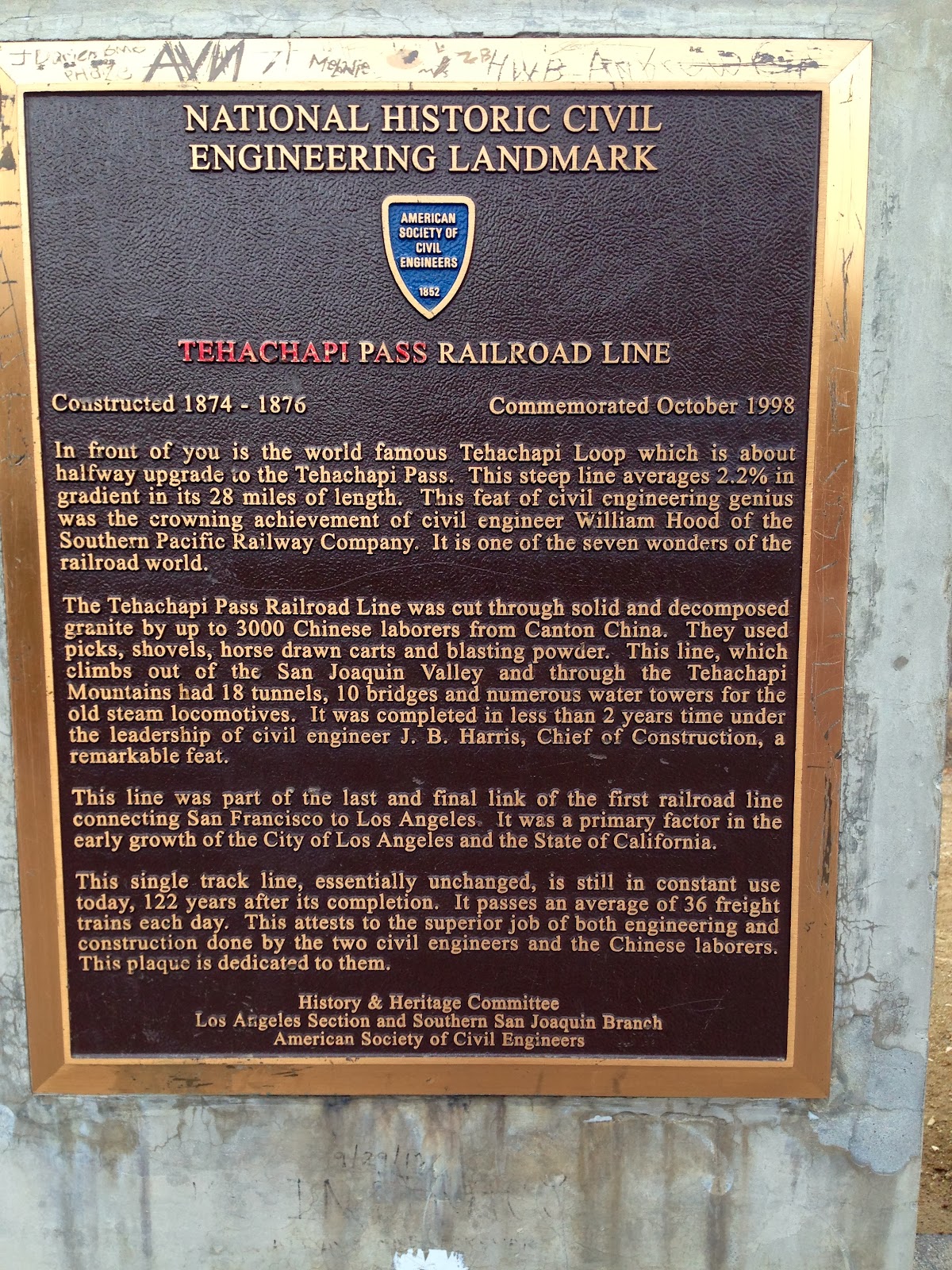
Our next stop was pretty amazing: the Tehachapi Loop (CHL #508).
The Tehachapi Loop is pretty amazing. It allows a train to climb a steep grade in a short amount of time. This photo that I took doesn't quite do it justice.
Here's a photo from Greg Loskorn that shows just how impressive the loop is. A long enough train can actually cross over itself as it ascends the grade.
Now, the American Society of Civil Engineers placed that beautiful plaque you saw above. In the copy, they claim that the Tehachapi Loop is one of the Seven Wonders of the Railroad World. This got me thinking: "Where are the other 6?" I scoured the internet looking for the list, and couldn't find it. So I tweeted the ASCE. As of the date of this posting (finally published on 2/17), they haven't responded. Does such a list really exist?


Our next stop was Bealville (CHL #741). Bealville is named for Edward Beale.

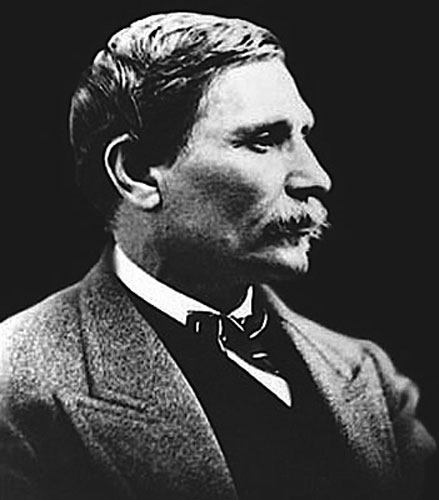
Edward Beale served in the Mexican-American War, received commissions from five different Presidents, and was the owner of the largest private landholding in the United States: Tejon Ranch.
Beale also convinced the US Army to establish Fort Tejon, one of the sites we visited on one of our previous adventures. 
The railroad was very important to this part of California, and we continued to see evidence of this as we followed the path of the railroad further north into Kern County.
The town of Caliente (CHL #757) served as the construction headquarters for the Union Pacific railroad in the 1870s, and it is still had dozens of railroad workers all around in the present day.

As we continue north, gold mining becomes a more significant part of Kern County history. Here is an old gold mining town and former county seat: Havilah (CHL #100).


As we descended from the mountains into the valley surrounding Lake Isabella, we entered the town of Bodfish. No historical markers here. I just like the name "Bodfish."
We finally got down into the valley, right near Lake Isabella. Here we found the Campsite of Edward M. Kern (CHL #742). John C. Fremont's led the expedition into the area, and named the river for his topographer, Edward M. Kern.
The river was dammed in 1953 by the US Army Corps of Engineers. In 2006, the dam was considered too unstable to fill to maximum capacity, and so currently the Army Corps of Engineers won't allow it to fill above 60%. No problem now with the drought that has affected California now for the past five years.
In our travels throughout California, Lake Isabella is just one of many bodies of water affected by the drought. The water barely even reaches the bottom of the dam right now.
From the valley basin, we headed back up into the mountains, this time stopping at another bygone gold mining town: Keyesville (CHL #98).

Maybe it's not so bygone after all? They had to put a sign prohibiting mining. Maybe there is still gold in them thar hills!
We traveled back around Lake Isabella, this time over to the west bank, to discover Kernville (CHL #132), another long-gone ghost town. This plaque had to be moved in the 1950s. Why? Because the original location of Whiskey Flat/Kernville is now located at the bottom of Lake Isabella.

Here is the old Kernville Cemetery, final resting place for a number of Kern County's original residents.
Back up into the hills we went! We traveled Highway 155 from Lake Isabella through the southern Sierra Nevada mountains, and we actually got to play in the snow!
We finally got up and over our final mountain pass, and into Glennville, where we discovered the Glennville Adobe (CHL #495), the oldest house in Kern County.

As you can see, it is not currently inhabited.
The next stop on our journey was Lavers Crossing (CHL #672). David Lavers built a hotel and stage stop here in 1859, and was the local postmaster. In 1870, the population dwindled to the point where the post office was forced to close and relocate to nearby Glennville.

Across the road from the Lavers Crossing plaque was this farm. Libi loved seeing the horses!
Adjacent to the plaque (and our car) was another property, guarded by this dog. He didn't care too much for our being there, and expressed his displeasure at our trespass. We cautiously re-entered our car.
We got back on the road and continued south and west, headed back toward Bakersfield. We were running out of daylight, so we had to hurry. Next was the Garces Baptismal Site (CHL #631). From the state: "Three miles north of this point was the site of the first recorded Christian baptism in the San Joaquin Valley. On May 23, 1776, Padre Francisco Garcés, earliest non-Indian in this area, baptized an Indian boy whom he called Muchachito at a Yokuts Rancheria in Grizzly Gulch."
 Unfortunately, the plaque has been stolen. Libi expressed her disappointment.
Like I said, we were racing for daylight, but on the plus side the setting sun made for a beautiful scene on the farmlands of Kern County.
Our second-to-last stop was another stop on the Butterfield Stage Line: Mountain House (CHL #589).
Is it really that slow around here in this part of Kern County? There are bullet holes in the plaque!
Final stop of the day was one more Butterfield stop: the Posey Station of the Butterfield Overland Mail Lines (CHL #539). We saw our very first Butterfield site back in downtown Los Angeles. Sadly, there was another stolen plaque, but happily, we visited our last site before we lost daylight!
On our next travels, we are headed to Calaveras County--Gold Country!

Saturday, January 25, 2014

We finished another county... - 1/25/2014

After a hiatus last weekend to celebrate Libi's birthday and suffer through the nasty stomach bug that hit our home, we are back on the CHL trail!  Today we decided to finish up our third county, Ventura!
Our first stop was the second mission we have encountered-- San Buenaventura (CHL 310). 
 One of the mission's claims to fame is that they are the only mission that originally had wooden bells.  These confounded Ron, but made perfect sense to me-- everyone has to have a gimmick, right?
Another interesting fact about their bells-- the bells that currently reside in their bell-tower were originally borrowed from Mission Santa Barbara, but they never returned them.
 The interior of the mission was extremely dark-- much like it would have looked during the mission days.  Luckily my camera sucked in enough light from the windows that I was able to get a few good shots without flash!
 This mission sanctuary is quite small, but 2000 people still call this their church home!
 I think that taking a photo in the mission courtyard with a fountain is going to be a tradition for us.
 Here is a photo of the bell-tower on this gorgeous Southern California January day!  There is one bell that still rings daily, it is inscribed with 'Hail Mary Most Pure. Mary of Zapopan Year of 1825." This bell was originally cast for the church of Zapopan, but was later sent to the mission. 
 Another obligatory photo with Fr. Serra!  Libi's comment, "We've seen this guy before."  Yes, my dear.  We will see him at every mission.
Interestingly, this mission was supposed to be the third one built, but due to postponement it is actually the 9th mission built.
 There is another CHL on the grounds of the mission that actually connects to one we saw months ago... the Old Mission Reservoir (CHL114).  The priests put the local Chumash people to work building an elaborate system of aqueducts to bring fresh water to the mission.  We saw the last remaining piece of the aqueduct in this post in October. 


After our very brief self-guided tour we headed across the street to take photos of the building.
Here is a side by side of Libi and I at the mission.  Libi's photo is from yesterday age 7, mine is from 1986 when I was around 9.  It's so funny to me that we were both standing in virtually the same spot almost 30 years apart.  For the record, I found this photo of myself after the fact, so we didn't purposefully stage these to be so similar.
 Daddy had to get into the act as well.
These trees in the photo are over 100 years old and according to the mission website:  "The twin 120-foot Norfolk pine trees in front of the mission (planted circa 1880) were designated California Millennium landmark trees by the American the Beautiful Fund in 2000."
It was a lovely morning at the mission!
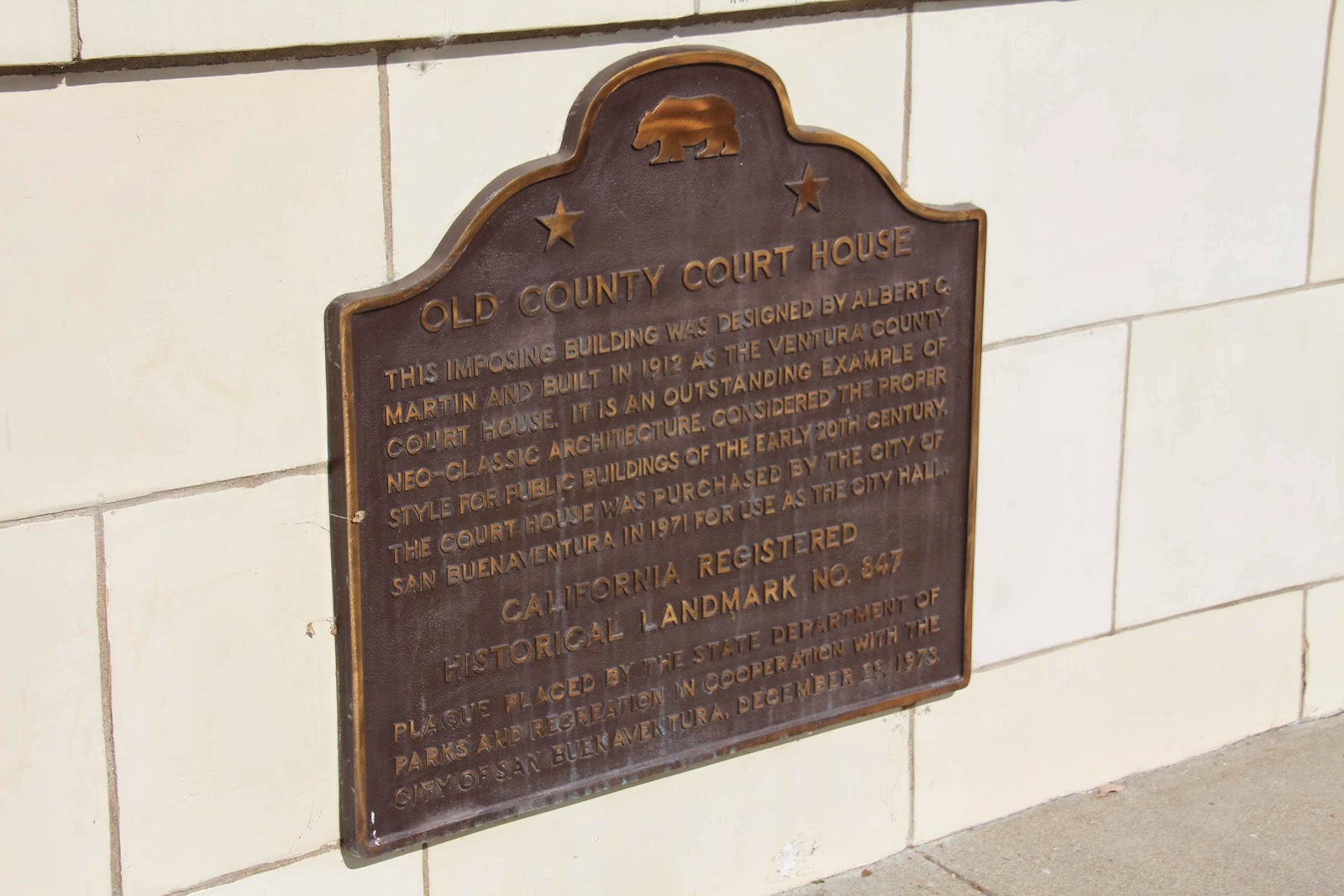
Our next stop was the Ventura County Courthouse building (CHL 847).  The reliefs on the side of the building look like something out of the Haunted Mansion...
We expected them to start singing to us at any moment, but sadly they just stared down at us.
The courthouse (which is now City Hall) was very quiet on this Saturday morning, which made it perfect for lots of photos.
The building was designed in 1910 by Albert C. Martin, Sr. using a neoclassical style.
The building was condemned due to earthquake damages, but was purchased by the city and repaired.  Thank goodness this gorgeous building wasn't' lost!
Next we left the city of Ventura and went to Newbury Park to the Stagecoach Inn (CHL 659).
This hotel was built in 1876, but burned to the ground in 1970.  It was completely restored using only hand tools and re-opened in 1976.  It had many names when it was a hotel--  The Grand Union Hotel, El Hotel Grande,The Conejo Hotel, and the Stagecoach Inn.
It is a great site-- with lots to see and do.  I even took my fifth grade students here for a field trip years ago!
One of the most fun things about this site is that all the docents (many of whom are retired school teachers) are dressed in period costume.  They even had a junior docent who was 11 years old who gave us a tour of the kitchen.
They don't allow any photography inside the hotel, but it was full of interesting displays-- a room full of phonographs, one of human hair art, dresses from the 1800's, and lots of photos and antique furniture. 
Libi loved all of it!  She even got to do a mini lesson in the school house where she wrote her name on a slate, looked at a third year reader, and rang the school bell.


They have a barn full of stage-coaches and tools. Here Ron is holding a brake that was put on the wagons when they were coming down steep grades to help the driver not lose control.
Libi got to use a corn seed planting contraption that was just her size!

After a fun few hours at Stagecoach we rushed over to Rancho Simi (CHL 979).  This site was closing at 4 p.m. so we wanted to have at least an hour to explore the grounds.
When we walked onto the site we were all impressed-- the grounds were large with lots of buildings.  Sadly, the docents were not very kind-- shoving us in front of a video, telling us there was nobody to show us the buildings (even though a docent in the back offered to take us), and then pushing us through the grounds so she could lock up.  It left a really bad taste in our mouth, so be careful when you go.  I would suggest going when they first open and hopefully they will be more hospitable! 
We did get to see the outside of the building-- inside this house two rooms of the original adobe that was built in 1892 still remain.
Our final Ventura County site was one of the 20th Century Fold Art Environments.  You might remember the first one, which totally creeped out Libi. 
Today we saw Grandma Prisbrey's Bottle Village (CHL 939).  Tressa Prisbrey, a 60 year old began using recycled bottles and items from the dump to build "shrines, walkways, sculptures, and buildings" from 1956 to the early 80's.
It was all locked up today, but they do give tours on occasion-- which would be fascinating to attend.


I don't think Libi spotted this sculpture or she might have given it a thumbs down just like the last 20th century folk artist.
So now, we have completed Ventura, Stanislaus and Merced counties!  We rock!

Format for hashmark fragment identifier

Click the edit icon to reveal code